



Virtual Test Bed - Infrastructures and Technologies for Virtual Testing of Automation Functions
Reason & Motivation
The development and testing of the technologies and functionalities required for automation in inland waterway transport necessitate a robust research infrastructure that can be adapted to different levels of technological maturity throughout the development process. To this end, the provision of a modular, configurable virtual testing and validation platform is an indispensable complement to real-world test beds.
Such a virtual test field not only allows for the early testing of automation components but also enables the risk-free conduct of safety-critical investigations, particularly of rare events that can only be carried out in real-world operations at high cost and with significant risks. Virtual testing also offers the opportunity to investigate a wide range of events in a short period of time with relatively little effort. The development and availability of a virtual test field is therefore an important prerequisite for ensuring the high level of safety required for automated driving.
While developments and demonstrators in real-world test environments are subject to a valid legal framework (laws and regulations) that, for the time being, does not yet exist for automated ships or systems, development and testing in a digital test environment can begin immediately, even without a valid legal framework. Given the potential of automation and the limited time available for research, this structural advantage is of extraordinary value.
Project objective
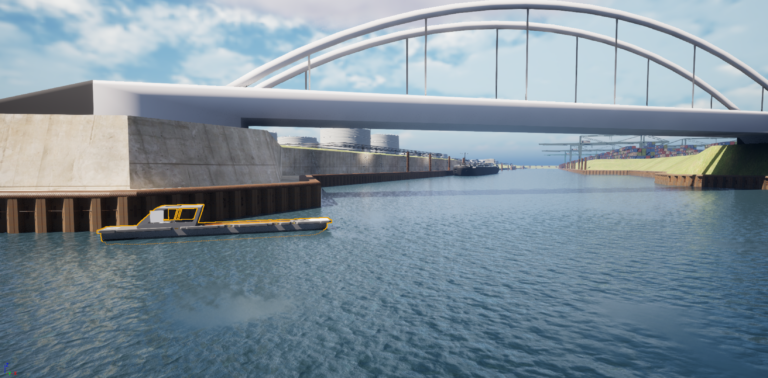
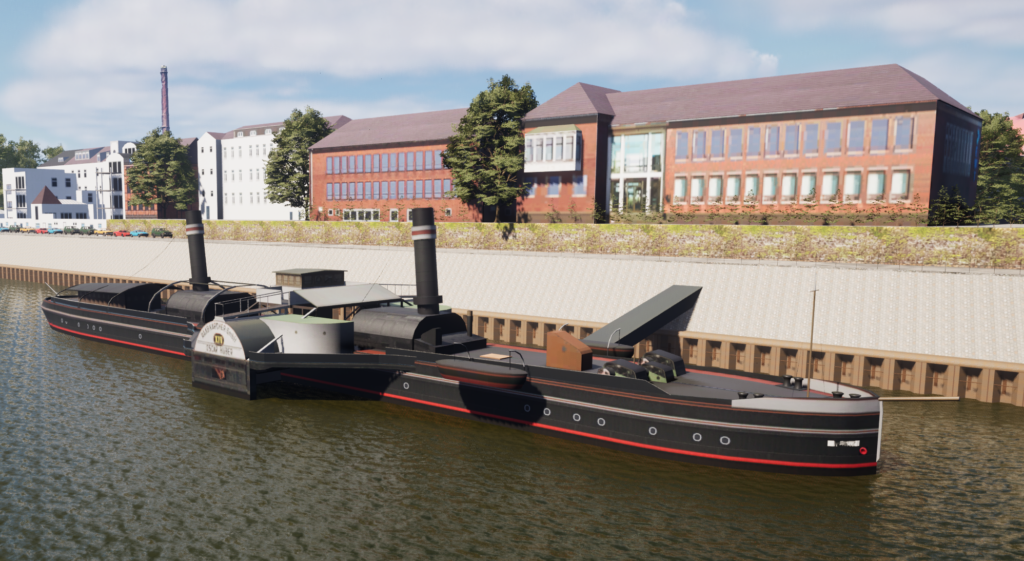
The goal of the project is to establish a virtual test environment that can be used to develop and test assistance systems and automation functions for the control and navigation of inland waterway vessels. The implementation will build on the existing infrastructure of the Test and Control Center for Autonomous Inland Waterway Vessels (VeLABi) and make it available as a generic test bed.
Outlook
Thanks to its modular configuration and open interfaces, VERA will, upon completion of the project, serve as an institution with national influence, available to a broad user base from research and industry for various research questions and initiatives in inland waterway transport.
Looking ahead, the insights gained in the digital test bed can also help substantially accelerate the development of the urgently needed legal framework for automated systems (see the SAFEBin project). This creates significant synergy potential with major benefits for other projects and demonstrators as well.

Partners involved
Term: 11/2022 to 02/2025 (extended to 06/2025)
Support program: BMDV / Förderrichtlinie zur Forschung und Entwicklung von Digitalen Testfeldern an Bundeswasserstraßen (DTW II)